

Discover our e-shop and access a digital catalogue of over 40.000 design products.
Go to shopFrom Inspiration to installation. Discover Mohd Interior Design Studio
Discover our e-shop and access a digital catalogue of over 40.000 design products.
Go to shop19 August 2026

A century later, Eileen Gray’s Bibendum still has something to say about how we want to live.
There are some items which go through time not getting old. Not because they stay the same all along but because they keep on speaking to our present times. One such example is Bibendum, an armchair designed by Eileen Gray in 1926, a chair that after a hundred years from its conception still carries its surprising power of challenging and representing an alternative modernism.
At a time when the geometric preciseness of the Bauhaus and the aesthetics of the machine were the main topics of discussion within architecture and design circles, Eileen Gray designed a chair that celebrated softness, comfort and sensual curved forms. And this was not only about design but also about culture.

Designed in 1926 for Jean Désert, Gray’s Paris gallery and showroom, Bibendum took its name from the iconic Michelin Man, whose stacked, cylindrical silhouette inspired the chair’s distinctive composition. Large upholstered tubular cushions are arranged to create an enveloping seat, transforming an industrial reference into an expression of domestic comfort. Its generous curves stand in deliberate contrast to the orthogonal volumes of early modernism, while the slender tubular steel frame gives visual lightness to an otherwise substantial form. Some design historians have also interpreted the chair as a subtle irony directed at the traditional gentlemen’s club chair, long associated with exclusively male spaces.


Bibendum’s enduring significance lies in its ability to capture many of the cultural tensions of the 1920s: the dialogue between art and industry, decoration and function, formal experimentation and everyday life. Although it has become one of the most recognizable icons of twentieth-century design, the armchair continues to feel remarkably contemporary.
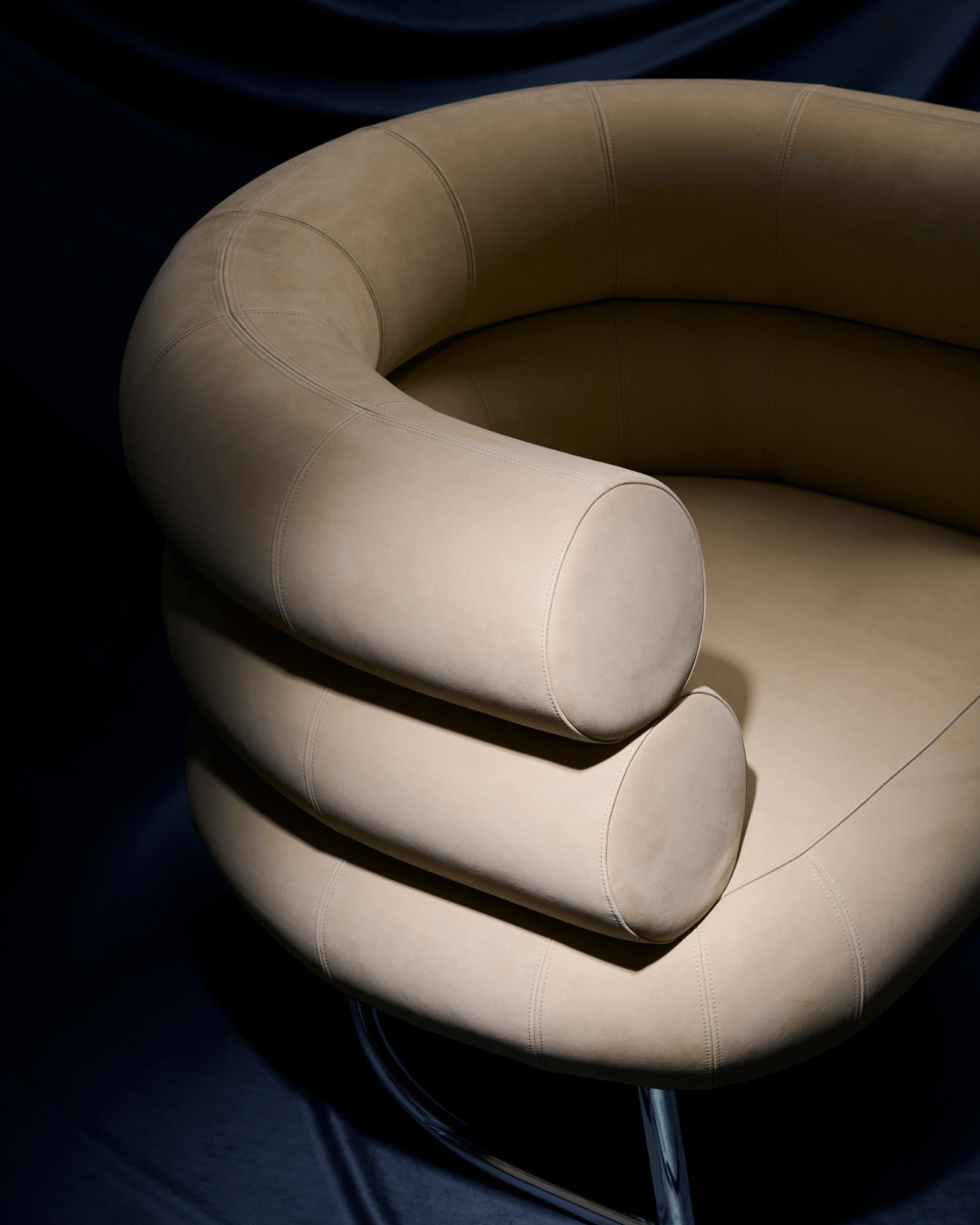
Its story also mirrors the critical rediscovery of Eileen Gray herself. Overshadowed for decades by many of the leading figures of the Modern Movement, Gray saw her contribution to design only fully acknowledged in the second half of the twentieth century. Indeed, today Bibendum is viewed as one of her signature pieces, and original versions of the chair have become highly valuable collectors’ items. An early example of Bibendum, created by Gray for the gallery’s Paris showroom, was sold in 2020 at auction, fetching USD 687,500.

To celebrate the chair’s centennial, ClassiCon, which holds the license to manufacture Eileen Gray’s furniture pieces, has released a special edition of 100 chairs, each with a certificate of authenticity and a number engraved on its frame. But Bibendum’s centennial is not only an occasion to hail a design icon — it is also a chance to revisit its rationale. In an era characterized by the need for speed and efficiency, the work of Eileen Gray serves as a reminder that effective design comes from an understanding of human habitation and space.
Maybe that is precisely the reason why Bibendum resonates even a hundred years later. Not because it hasn’t changed, but simply because it still asks those timeless questions: What kind of relationship do we want to have with our surroundings? How does space influence the way we live, communicate, and feel at home?
The greatest icons of design persist not as monuments, but as living organisms. And Bibendum, with its exceptional combination of formal boldness, comfort, and humanity, proves once again that it is only through timelessness that design can truly transcend itself.
Related articles