

Discover our e-shop and access a digital catalogue of over 40.000 design products.
Go to shopFrom Inspiration to installation. Discover Mohd Interior Design Studio
Discover our e-shop and access a digital catalogue of over 40.000 design products.
Go to shop29 April 2026

From Tito Agnoli’s P3 to the Elogio Sofa by Afra and Tobia Scarpa, the Danish brand brings to Via Macchi 82 a collection that challenges the very notion of novelty.
During Design Week, Milan reinvents itself every year: new spaces open, previously unknown addresses circulate among insiders, and the city’s map is rewritten in a matter of days. Yet amid all this movement, some places return rediscovered with the same ease as a familiar destination. Via Macchi 82 is one of them. Mohd Officina Milano has that rare quality of not needing to reinvent itself each season: it welcomes, lets the content speak, and manages to surprise every year without betraying its identity.
As soon as you step inside, a broad, immediate brightness gives the space an unexpected sense of openness. It’s the unmistakable signature of Gubi, the Danish brand founded in 1967 by Gubi Olsen and his wife Lisbeth, with a philosophy that has remained unchanged over time: timeless Scandinavian design, where Nordic elegance, craftsmanship, and everyday functionality coexist without compromise. On the right, the Gubi team welcomes guests with breakfast: for three different mornings, the space transformed into a setting for genuine conversation, inviting architects, interior designers, entrepreneurs, and friends of the brand to explore materials, from stone to rattan, and the meaning behind each design choice.
“During Design Week, we host three breakfast workshops to talk about how Gubi works with materials. It’s a concrete opportunity for architects and interior designers to truly understand our approach: from stone to rattan, all the way to the artisanal complexity behind each piece.”
— Emma, Head of Europe South & Benelux, Gubi
The spatial journey unfolds dynamically, organized into different settings, and quickly leads to the first standout piece: the P3 & P3S, designed in 1964 by Italian architect Tito Agnoli for Bonacina 1889 and now reintroduced through a collaboration between Gubi and the historic Italian manufacturer. Two postwar design icons, faithful to the original archive drawings yet reimagined for today: now available in synthetic rattan for outdoor use, weather-resistant, bringing the P3 outside for the first time and making the P3S Gubi’s first lounge chair. Each piece is unique: subtle variations from handcrafting are the signature of a process that cannot, and does not seek to, be replicated industrially.
“The P3 and P3S are archive pieces by Tito Agnoli, originally designed for Bonacina. This year we’ve brought them back to life, for both indoor and outdoor use, with absolute attention to the artisanal quality of rattan. It’s a dialogue between Italy and Denmark that makes a lot of sense today.”
— Alberto Del Prete, Senior Designer & Product Developer, Gubi
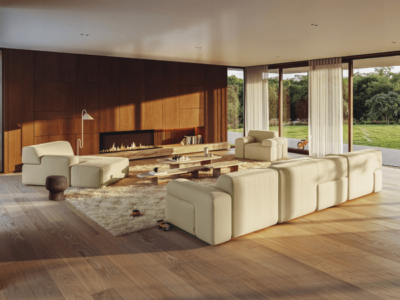
In conceiving the Interior Reflections installation for Mohd, Studiopepe chose to interweave the Gubi collection with pieces from other brands, a gesture that expresses their vision through images rather than statements. The Basket Lounge Chair, with its steel frame wrapped in handwoven rattan, enters into dialogue with the Elogio Sofa by Tobia and Afra Scarpa, reissued with Gubi fifty years after its original creation: the same modular architecture from 1974, refined geometry, and upholstery enriched with the new Reales and Fustagno fabrics. Two pieces from different eras coexist as if they had always belonged together.


This is precisely the deeper meaning of Interior Reflections: a space where surfaces, reflections, and contrasts intertwine, revealing the layered complexity of the contemporary home. Material becomes language. What is visible engages with what is reflected. Not merely an installation, but a perspective on domestic interiors that asks, and deserves, to be experienced with attention.
Leaving Via Macchi 82, the feeling is of having passed through a space that had something to say and expressed it with restraint. One question lingers: in an industry constantly producing the new, how bold, and necessary, is the act of returning to a 1964 design, studying it, respecting it, and bringing it into the present without betraying it? Agnoli’s rattan is not nostalgia. It proves that certain designs already contain everything they need. Perhaps the role of design is not always to invent, but to recognize what does not need improvement, only deeper understanding.
Related articles