

Discover our e-shop and access a digital catalogue of over 40.000 design products.
Go to shopSpring Days | Use the coupon code SPRING15 to get 15% off on purchases starting at 480€ and SPRING20 to get 20% off on purchases starting at 4800€
Discover our e-shop and access a digital catalogue of over 40.000 design products.
Go to shop11 December 2025
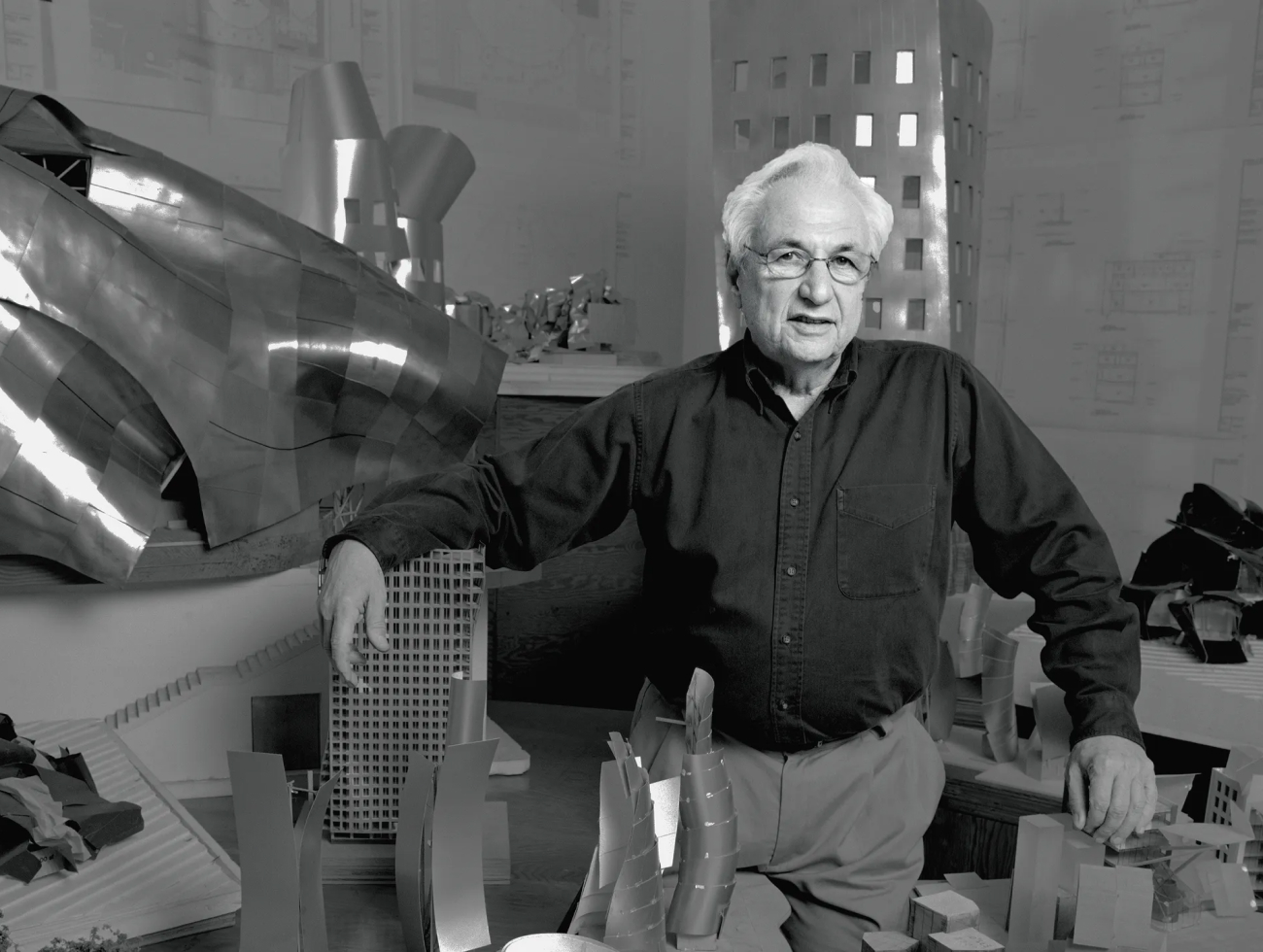
Frank Gehry, a towering presence in contemporary architecture and the author of Bilbao’s celebrated Guggenheim, passed away on 5 December 2025 at the age of 96. With his fluid geometries, unconventional materials, and unmistakable architectural language, he reshaped skylines and left an equally lasting imprint on the world of design through notable collaborations with Vitra and Knoll, where his ideas took on the scale of everyday objects.
Frank Gehry died in his Santa Monica home, closing a chapter in the history of architecture that stretched across nearly a century. Born in Toronto in 1929 and later naturalized American, he went on to design some of the most iconic buildings of our time: from the Guggenheim Museum in Bilbao to the Walt Disney Concert Hall in Los Angeles, and the Fondation Louis Vuitton in Paris.
We remember him for those sweeping titanium curves, the façades that seem to shift as you move past them, the structures that defy symmetry and expectation. But above all, Gehry is remembered for overturning the conventions of building itself. He didn’t simply design architecture; he sculpted space.
From the 1970s onward, his work stood apart for its embrace of humble materials—cardboard, chain-link, corrugated metal—and for a formal language that rejected classical geometry. His now-legendary Santa Monica residence, reimagined in 1978, was an irreverent collage of industrial elements. It startled the neighborhood and became a foundational moment for deconstructivism.
Gehry did not create “beautiful” houses in the traditional sense. He created structures that were alive, provocative, impossible to ignore.One of his first major European landmarks, the Vitra Design Museum (1989) in Weil am Rhein, marked a pivotal moment. Conceived initially to showcase Vitra’s design collection, it soon evolved into an independent foundation dedicated to research and the culture of design. Its fractured volumes, towers and ramps, and evocative natural light made it one of the earliest and most compelling expressions of deconstructivism in Europe—today considered among the world’s leading design museums.

Walt Disney Concert Hall

Vitra Design Museum
The museum that changed everything
The Guggenheim in Bilbao, inaugurated in 1997, was the turning point—an architectural event. The building appears almost dreamlike, as if shaped by wind, water, and metal in collision. Its curved titanium skin captures the shifting light of the sky and the Nervión River. It didn’t just transform the city; it transformed the idea of what a museum could be. After Bilbao, the container often became as iconic as the collection it held.
Gehry received the Pritzker Prize in 1989, architecture’s equivalent of the Nobel, recognizing his radical contribution to the discipline. His accolades soon multiplied: Japan’s Praemium Imperiale (1992), the AIA Gold Medal (1999), and Spain’s Princess of Asturias Award for the Arts (2014).

An evolving legacy
Gehry continued working well into his nineties. In 2025 he began the CMU Museum of Fine Arts in Taiwan. The long-awaited Guggenheim Abu Dhabi was slated for a 2026 opening. Meanwhile, in Beverly Hills, he was developing a monumental new flagship store for Louis Vuitton—a 100,000-square-meter vision where fashion, art, and architecture converged.

Frank Gehry leaves behind an enduring legacy. He redefined architecture as a total creative act, balanced between sculpture and engineering, intuition and digital experimentation. He showed that even titanium can become a storyteller.
In saying goodbye, we honor the creator of some of the world’s most astonishing buildings—the man who gave form to chaos and uncovered beauty in places where once there was only function.
“Architecture should speak of its time and place, but yearn for timelessness”.